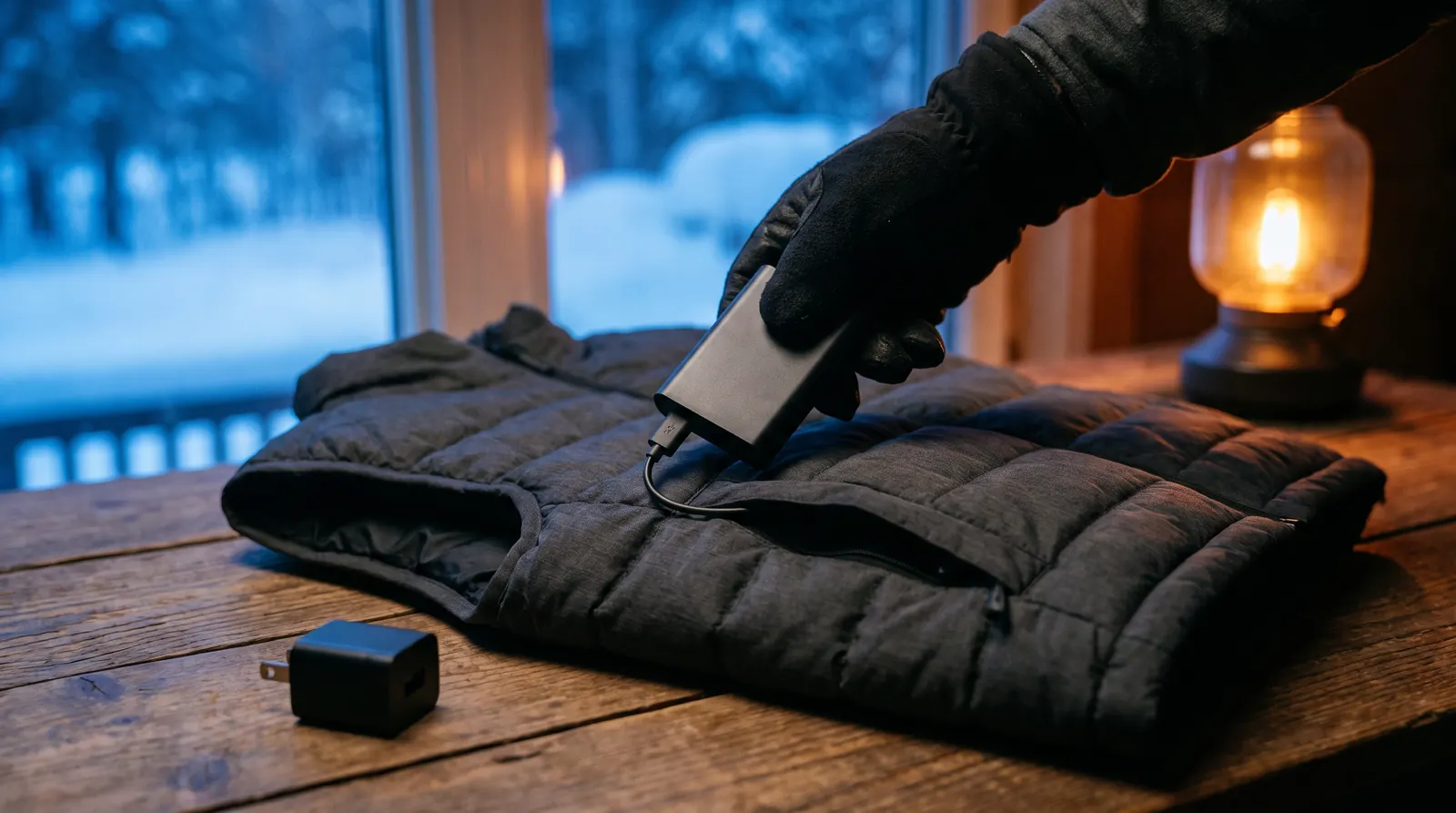
Short answer: How long a heated vest battery lasts comes down to three things: how much energy it stores in watt-hours, which heat setting you use, and how cold it is outside. The "up to" number on the box almost always refers to the lowest setting. On high, you often get a quarter to a third of it. Real cold cuts that further.
Heated vest battery basics: volts, mAh and watt-hours
Every battery lists two numbers: voltage (V) and capacity in milliamp-hours (mAh). Most heated vests, gloves and socks run at 7.4 V. Some use 3.7 V, and tool-battery gear runs at 12, 18 or 20 V.
On its own, mAh is misleading. What matters is how much energy the battery holds, measured in watt-hours (Wh):
Wh = V × Ah (1,000 mAh = 1 Ah)
Here's an example from our comparison. The Fieldsheer Pro Merino sock battery is 3.7 V and 3,600 mAh: 3.7 × 3.6 = 13.3 Wh. The Ororo Tahoe 4.0 battery is 7.4 V but only 2,200 mAh: 7.4 × 2.2 = 16.3 Wh. The pack with the smaller mAh number actually stores more energy.
Newer batteries often print the Wh rating right on the label. If yours doesn't, use the formula.
How long does a heated vest battery last?
The table lists heated vests from our comparison where the manufacturer gives battery specs and runtime. We calculated Wh from voltage and capacity unless the brand states it. All runtimes are the manufacturer's, for one battery.
| Heated vest | Voltage | Capacity | Energy | Runtime low / medium / high |
|---|---|---|---|---|
| Ororo Women's Classic Evo | 7.4 V | 5,075 mAh | 37.5 Wh | 7.5 / 4.5 / 2 h |
| Gerbing Khione Puffer 2.0 | 7 V | 3,400 mAh | 25.16 Wh (stated) | 8 / – / 2 h |
| Fieldsheer Alpine 3.0 | 7.4 V | 2,250 mAh | 16.7 Wh | 9 / – / 2 h |
| Venustas M2118 | 7.4 V | – | 36 Wh (stated) | up to 9.5 h, no setting given |
| ActionHeat Pro Series+ Puffer (women's) | not stated | 10,000 mAh | – | 6 / 3 / 2 h |
| Makita DCV202 (Europe) | 18 V | 6,000 mAh | 108 Wh | 35 / 20 / 10 h |
So per the manufacturers, a typical heated vest battery lasts 7.5 to 9.5 hours on low and about 2 hours on high. Only tool-battery vests go much further – and Makita's 6.0 Ah pack is heavy and over the 100 Wh airline limit.
Divide watt-hours by runtime on high and you get average heating power. For the Ororo Classic Evo, that's 37.5 ÷ 2 = about 19 W. For the Fieldsheer Alpine, 16.7 ÷ 2 = about 8 W. More heat zones and higher temperatures burn more energy. That's why the Fieldsheer, with the smallest battery here, still runs longer on low than the Ororo.
Worked example: will a heated vest battery last a night game?
Say you're at an outdoor game for 5 hours: 1 hour on high while you settle in, then 4 hours on medium. Each hour on a setting uses 1 ÷ rated runtime of the battery.
Ororo Women's Classic Evo (37.5 Wh): - 1 hour on high: 1 ÷ 2 = 50% of the battery - 4 hours on medium: 4 ÷ 4.5 = 89% of the battery - Total: 139%. You'll run out in the fourth quarter unless you bring a spare.
Makita DCV202 (108 Wh): - 1 hour on high: 1 ÷ 10 = 10% - 4 hours on medium: 4 ÷ 20 = 20% - Total: 30%. Plenty left – but you're wearing a 108 Wh tool battery.
These numbers use the manufacturer's ratings. At 20 °F (−7 °C), real runtime will be shorter. Build in at least an hour of cushion.
Heated jacket battery life
A heated jacket battery is often the same pack as the brand's vest battery, but jackets tend to have more heat zones. Here's what the manufacturers list:
| Heated jacket | Battery | Energy | Runtime low / medium / high |
|---|---|---|---|
| Ororo Overland Men's (7 zones) | 7.4 V / 5,075 mAh | 37.5 Wh | 8.5 / 5 / 3 h |
| Ororo Toasty Hoodie (5 zones) | 7.4 V / 5,075 mAh | 37.5 Wh | 9.5 / 5.5 / 3.5 h |
| Fieldsheer Outrider Women's | 7.4 V / 2,250 mAh | 16.7 Wh | 9 / – / 2 h |
| Milwaukee M12 AXIS Quilted | 12 V / 3.0 Ah | 36 Wh | 12 / 6 / 3 h |
| DeWalt DCHJ066 (women's) | 20V MAX (18 V nominal) / 1.5 Ah | 27 Wh | 7 h on low |
| Venustas W2168 (women's) | 7.4 V | 72 Wh (stated) | up to 20 h, no setting given |
Two Ororo pieces use the same 37.5 Wh battery, yet the seven-zone Overland jacket runs an hour less on low than the five-zone hoodie. Zones cost energy. Venustas pairs its jacket with a much larger 72 Wh battery – still well under the 100 Wh airline limit.
Heated gloves and socks: smaller batteries
Gloves and socks carry much smaller batteries. Each row is one battery – one glove or one sock.
| Model | Type | Voltage | Capacity | Energy | Runtime low / high |
|---|---|---|---|---|---|
| Ororo Glasgow | Glove liner | 7.4 V | 2,000 mAh | 14.8 Wh | 8.5 h / 3 h |
| Glovii GS9 | Ski glove | 7.4 V | 2,100 mAh | 15.5 Wh | 6 h / 2 h |
| Savior Heat EH8 Pro | Mitten | 7.4 V | 3,000 mAh | 22.2 Wh | 12 h / 3 h |
| Fieldsheer Pro Merino | Sock | 3.7 V | 3,600 mAh | 13.3 Wh | 13 h / 4 h |
| Ororo Tahoe 4.0 | Sock | 7.4 V | 2,200 mAh | 16.3 Wh | 11.5 h / 3 h |
| Savior Heat Magsnapic | Sock | 7.4 V | 2,200 mAh | 16.3 Wh | 13 h / 5 h |
| G-Heat Outdoor V2 | Sock | 7.4 V | 2,600 mAh | 19.2 Wh | 6 h / 2.5 h |
Two things jump out. First, more watt-hours don't automatically mean longer runtime. The G-Heat sock has the biggest battery here and the shortest runtime. Second, Savior Heat and Ororo use the same size battery in their socks. Yet Savior Heat claims 5 hours on high and Ororo claims 3.
The difference is heat output. The hotter a garment runs, the faster it drains the battery. None of these brands cite a shared testing standard for runtime. So compare runtimes across brands with a grain of salt.
Worked example: will it last a day on the mountain?
Say you ski from 9 a.m. to 4 p.m. – 7 hours. It's 5 °F (−15 °C) in the morning, so you want high for the first 2 hours, then low.
- Savior Heat EH8 Pro (22.2 Wh): 2 hours on high uses 2 ÷ 3 = two-thirds of the battery. The last third lasts a third of 12 hours on low – 4 hours. Total: 6 hours, just short of 7.
- Ororo Glasgow (14.8 Wh): Same two-thirds gone after 2 hours on high. What's left covers about 2.8 hours on low. Total: just under 5 hours.
Cut high to one hour and the EH8 Pro looks better: two-thirds left, which is 8 hours on low. That's 9 hours total.
Why "up to X hours" means the lowest setting
The biggest number sells, so that's the one on the box – the weakest setting. Often the listing doesn't even say which setting it means. A few examples from our data:
- G-Heat advertises "up to 8 hours" for the Outdoor V2. The runtime table on the same page tops out at 6 hours on low.
- Fieldsheer's Premium BT insoles say "up to 9 hours" in the headline and "7+ hours" in the specs.
- Therm-ic's data sheet for the Thin Ultra Heat Liner lists its "up to 7.5 hours" as a "warm-up time."
- Ororo's Women's Classic Evo page lists 7.5 / 4.5 / 2 hours in its spec table, while the FAQ on the same page gives 8 / 5 / 2.5 hours for a different battery variant.
The gap between settings is big. The Savior Heat EH8 Pro mitten is rated at 12 hours on low and 3 on high. High burns through energy four times as fast. Gerbing's Khione vest shows the same pattern: 8 hours at 25% power, 2 hours at 100%.
How cold weather cuts heated vest battery life
Lithium batteries deliver less usable energy in the cold. The chemistry inside the cell slows down, and part of the charge stays locked up until the battery warms again. Manufacturer runtimes generally aren't measured in freezing conditions.
What helps:
- Start warm: Charge at room temperature and keep the battery in an inside pocket until you head out.
- Keep it close to your body: A vest battery usually rides in an inside pocket and stays fairly warm. A battery in a glove cuff or at your calf cools off faster.
- Don't charge below freezing: Lithium batteries shouldn't be charged when they're below 32 °F (0 °C). Let them come up to room temperature first.
- Store smart: Over the summer, keep batteries partly charged – not full, not empty.
Charging: how long does it take to charge a heated jacket battery?
Few manufacturers list charging time. For the vest and jacket batteries in our comparison, none of the product pages do. Here's what we have:
| Battery (product) | Energy | Charging time (manufacturer) |
|---|---|---|
| Ororo B22A (Glasgow liner), 7.4 V / 2,000 mAh | 14.8 Wh | 2.5 h with a 5V/3A charger |
| Ororo Mini 5K (Bay City hand warmer), 7.4 V / 4,800 mAh | 35.5 Wh | 4 h |
| Fieldsheer Powersheer Micro (Pro Merino socks), 3.7 V / 3,600 mAh | 13.3 Wh | 4–5 h |
| G-Heat BATS04 (Outdoor V2 socks), 7.4 V / 2,600 mAh | 19.2 Wh | 4–5 h |
| Therm-ic C-Pack 1300B (Heat Flat insoles) | – | 5–7 h, wall adapter not included |
In general – and this isn't a manufacturer figure – charging time depends on the battery's watt-hours and the charger's output. A weak USB adapter charges slower than the one in the box, and lithium batteries slow down near full. Ororo's Mini 5K is roughly the size of its PD 5K vest and jacket battery. So as a rough guide, plan on several hours for a heated jacket battery of that size. Charge it the night before and it'll be full in the morning.
When a spare battery is worth it
If your math comes up short, a spare battery is the easy fix. Prices vary a lot:
- G-Heat sells its EVO women's vest without a battery for €139.90 and with one for €169.90 – the battery works out to €30.
- Ororo's SureWarm Classic Pro vest (sold in Europe) has two battery pockets. With a second PD 5K pack, sold separately, Ororo lists up to 14 hours on low.
- Lenz sells its Heat Vest 3.0 without batteries. The Lithium Pack rcB 2000 costs €219.95 – more than the €139.95 vest.
- For gloves, G-Heat sells its Nordic ski glove without batteries for €119.90, with one pair for €159.90 and with two pairs for €199.90. The second pair costs €40.
- Therm-ic's S-Pack 4000B costs €229.95 and is rated at up to 23 hours in its Ultra Warm socks.
Tool-battery gear like Milwaukee's M12 jackets runs on the same packs as your drills. If you already own a few, you have your spares. See our heated vest comparison for the options.
Do the math before you buy. A model with a bigger battery is often cheaper than a small one plus a spare. Runtimes for every model are in our heated gloves and heated socks comparisons.
Power bank systems: 5 V vs. 7.4 V
A 7.4 V battery is two lithium cells in series. A standard USB port puts out 5 V. That gives you two kinds of systems:
7.4 V batteries: Most heated vests, gloves and socks use them – Ororo, Fieldsheer and Gerbing among them. At the same current, the higher voltage delivers more heating power. The downside: you need the maker's own battery, and spares cost more.
5 V power banks: Some vests and jackets run off a USB port. ActionHeat ships its Pro Series+ Puffer Heated Vest with a 10,000 mAh power bank. Glovii even calls the batteries for its GQ3 socks power banks. The upside: you can often charge your phone from it, too.
Watch the mAh rating on power banks. It usually refers to the internal cell voltage – 3.6 to 3.7 V – not the 5 V output. A 10,000 mAh power bank stores roughly 36 to 37 Wh. ActionHeat doesn't list a voltage for its own pack.
Can I use any power bank for a heated vest?
Only if the vest is built for USB power banks. On a 7.4 V vest, neither the plug nor the voltage matches. Never plug a 7.4 V garment into a power bank unless the manufacturer says it's supported, and vice versa. The wrong voltage can damage the heating element or simply leave it cold.
For USB vests, some general guidance – our data doesn't include a manufacturer rule on this: the connector has to match, USB-A or USB-C. ActionHeat ships a PD power bank, meaning USB Power Delivery, so pick a spare that supports the same standard. And check the watt-hours: a smaller power bank than the original means proportionally shorter runtime.
Batteries on a plane
Most heated vest and jacket batteries sit far below the FAA's 100 Wh limit. Tool batteries can be the exception: Makita's DCV202 heated vest runs on 18 V packs. An 18 V, 6.0 Ah pack works out to 108 Wh, which is over the limit and restricted to two spares per person. Our guide to heated clothing on planes covers carry-on rules and power banks.
Want to know how much heat you actually need for your conditions? Try the Warmth Finder.
Frequently asked questions
How long does a heated vest battery last on high?
Per the manufacturers in our comparison, about 2 hours on high and 7.5 to 9.5 hours on low for a typical vest. Tool-battery vests go longer – Makita lists 10 hours on high with a 6.0 Ah pack. In freezing temperatures, expect less than the rated figure.
How do I convert mAh to watt-hours?
Divide mAh by 1,000 and multiply by the voltage. 5,075 mAh at 7.4 V is 5.075 × 7.4 = 37.5 Wh. Watt-hours are the only fair way to compare batteries with different voltages.
Why does my heated vest battery die faster in the cold?
Lithium batteries release less usable energy when they're cold. Some of the charge comes back once the battery warms up. Keep spares in an inside pocket.
Can I run heated clothing off a power bank?
Only if the manufacturer supports it. Gear with a USB connector runs on 5 V and works with many power banks. Gear built for 7.4 V batteries needs the original battery.
Is a spare battery worth it?
If your runtime math is tight for a full day, yes. In our comparison, spares range from about €30 for a G-Heat vest battery to €229.95 for a Therm-ic S-Pack 4000B. Check whether a model with a bigger battery costs less overall.
Can I charge heated clothing batteries when they're cold?
No. Lithium batteries shouldn't be charged below freezing. Bring them up to room temperature first, then charge.
Keep reading
* Links marked * are affiliate links. If you buy through them we may earn a commission at no extra cost to you. Placements can't be bought.