Pro Series+ Bluetooth Heated Insoles
ActionHeat
- Runtimelow8 hmedium5 hhigh3 h
- Max. temperature140 °F
- Heat levels3
The best balance of stated runtime and price in this comparison.
$149.99per manufacturer, Sep 30, 2026
Check price*
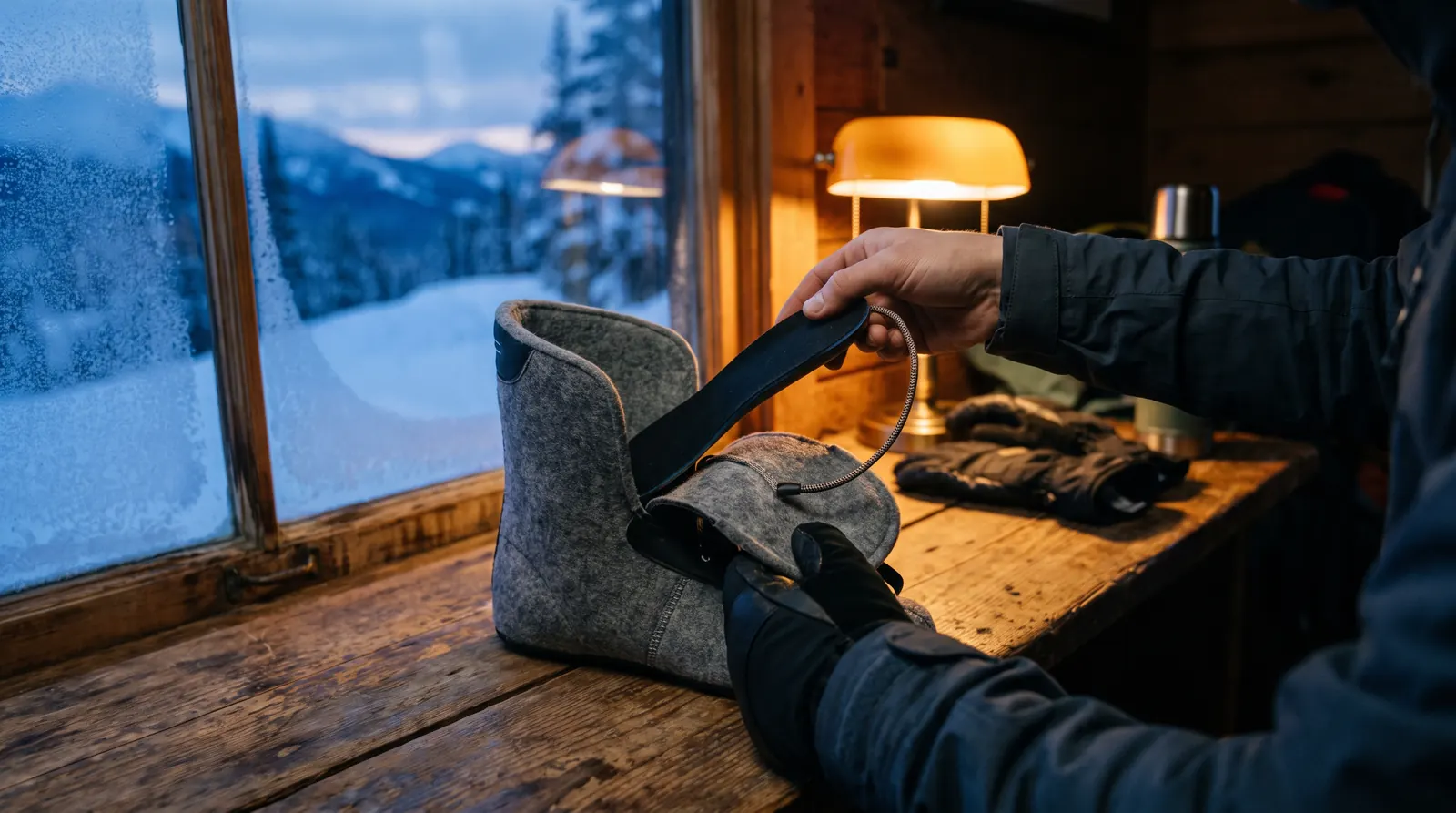
Heated insoles fit the boots you already own – ski boots to work boots. We compare battery, runtime and controls, and tell you when heated socks are the better choice.
Updated September 30, 2026 · 6 models · manufacturer specs with sources only
ActionHeat
The best balance of stated runtime and price in this comparison.
Fieldsheer
Another documented option with a different focus.
Short answer: Heated insoles warm your feet from underneath and drop into almost any boot you already own. For work boots, pac boots and everyday wear, insoles with a built-in battery and a remote are the easy choice. For ski boots, go with a flat insole and an external battery on the boot cuff. Manufacturer claims in our comparison run from 6 to 24 hours – usually without saying which setting.
A heated insole is a footbed with a thin heating element built in. On almost every model, the element sits under the forefoot – the toes and the ball of the foot. That's where you lose heat first. The heel usually stays unheated.
There are two designs:
Built-in batteries are more convenient day to day. External batteries hold more energy, swap faster and take up less room under your foot.
This is the real question to settle before you buy. Both warm your feet, but in different ways.
Why insoles:
Why socks:
Our take: In roomy winter boots, work boots and rubber boots, insoles are the more practical pick. In a snug, custom-fit ski boot, a heated sock is often more comfortable. If it's the tops of your toes that go numb, an insole won't help much. Compare the options on our heated socks page.
A ski boot has almost no spare room. Every millimeter under your foot changes the fit. That's why ski insoles are flat and keep the battery on the outside.
Here's how installation usually goes:
If you're not sure, have a ski shop boot fitter do it. Hotronic takes a different approach: the heating element comes pre-installed in a Bootdoc anatomic footbed that replaces the one in your liner.
Test everything at home before your trip. A badly routed wire is something you only notice an hour into your first run.
Many brands give a single number. Lenz says "up to 22 hours," Therm-ic "up to 13," Sidas "up to 8" and Hotronic "24 hours." None of them say which setting. Assume it's the lowest.
Fieldsheer's own page contradicts itself: the specs say 7+ hours, while the headline says up to 9. We use the lower figure.
ActionHeat gives numbers for every setting: 8, 5 and 3 hours. That's the kind of detail you want.
Insoles with built-in batteries don't have much room for cells. The Fieldsheer Premium BT uses a 3.7 V, 2200 mAh battery – about 8.1 Wh. A typical 7.4 V, 2200 mAh heated sock battery holds 16.3 Wh, twice as much. External ski batteries are bigger: Hotronic lists 6,000 mAh for the XLP 2C BT.
Our heated clothing battery life guide explains how to turn watt-hours into a realistic runtime.
Every lithium battery delivers less usable energy in the cold. An external battery on a ski boot hangs out in the wind. A built-in battery sits inside a warm boot, but it's smaller. Either way, treat the box figure as a ceiling, not a promise.
You can't reach a button inside your boot. That's why nearly every model has a wireless remote, an app, or both. A remote is often quicker than a phone when you're wearing gloves at 5 °F (-15 °C). An app gives you finer control. ActionHeat offers both.
Every insole in our comparison ships with batteries. Details still differ. ActionHeat charges over dual Micro-USB rather than USB-C. Therm-ic includes a USB cable but no wall charger, and quotes 5 to 7 hours to charge.
The table lists every model with the manufacturer's own figures. Sort by price, runtime or battery. Blank cells mean the brand doesn't publish that number.
| Model | Runtime (low/med/high) | Battery | Price |
|---|---|---|---|
| ActionHeat Pro Series+ Bluetooth Heated Insoles Everyday · Hunting · App · Heating zone: Toes |
8 h 5 h 3 h |
n/amax. 140 °F | $149.99
Check price*
|
| Fieldsheer Premium BT Wireless Heated Insoles Everyday · App · Heating zone: Toes |
7 h |
3.7 V2200 mAh8.1 Whmax. 135 °F | $169.99
Check price*
|
| Hotronic XLP 2C BT Anatomic Ski · App · Heating zone: Forefoot (built-in heating element) · other market |
24 h |
n/a | n/a
Check price*
|
| Lenz Set: Heat Sole 1.0 + Lithium Pack Insole rcB 1200 Ski · Everyday · Heating zone: Toes · other market |
22 h |
n/a | n/a
Check price*
|
| Glovii GW2 heated insoles with remote Everyday · Remote · Heating zone: Forefoot · other market |
9 h 5 h 3 h |
n/amax. 111 °F | n/a
Check price*
|
| Glovii GW4U ultra-thin heated ski insoles Ski · App · Heating zone: Forefoot · other market |
8 h 4 h 2 h |
n/amax. 111 °F | n/a
Check price*
|
All values from the manufacturer's page, retrieved September 30, 2026. “n/a” = not stated by the manufacturer. Runtimes are usually quoted at room temperature. Models marked “other market” have no US dollar price listed.
At $149.99, this is the most affordable US insole in our comparison. The 3.7 V battery is built in, and you control it with a wireless remote or the app. The three settings run at 100, 120 and 140 °F (38, 49 and 60 °C), rated at 8, 5 and 3 hours. They trim to fit and come in S/M and L/XL.
Best for: work boots, hunting boots and everyday cold. Keep in mind: ActionHeat doesn't list battery capacity, and charging is Micro-USB.
These cost $169.99 with a built-in 3.7 V, 2200 mAh battery. There are four settings from 90 to 135 °F (32 to 57 °C), controlled by a touch button or the MW Connect app. They're trimmable.
Best for: commuters and anyone who wants app control without wires. Keep in mind: Fieldsheer lists both 7+ and up to 9 hours on the same page. At about 8.1 Wh, the battery is modest.
This is a complete ski system: a Bootdoc anatomic footbed with the heating element already built in, plus XLP 2C BT batteries rated at 6,000 mAh. You get three settings plus a power boost, all in the app. Hotronic claims 24 hours.
Best for: skiers who want a finished system with no trimming. Keep in mind: Hotronic sells through dealers only, so there's no list price on its site. The 6,000 mAh and 24-hour figures come from different pages.
The Austrian set costs €189.95 with two rcB 1200 batteries and a charger. Lenz promises "warmth for up to 22 hours" without naming a setting. The insole trims to size, and the battery sits outside the boot with stepless app control.
Best for: skiers heading to the Alps. Keep in mind: Lenz doesn't list voltage or capacity on the product page.
This flat insole spreads heat evenly across the sole, according to Therm-ic. The €199.99 set includes a Bluetooth C-Pack 1300B battery. Therm-ic rates it at up to 13 hours.
Best for: tight-fitting ski boots. Keep in mind: No wall charger in the box, and charging takes 5 to 7 hours.
Skiing: flat insole, external battery, ideally with an app. Hotronic, Lenz and Therm-ic are built for this.
Work and everyday: built-in battery with a remote. They move from boot to boot without wires, as long as the size matches.
Hunting: long runtime while sitting still is what counts. We compare insoles and socks for the stand in our heated hunting gear guide.
Not sure whether your feet, hands or core get cold first? The Warmth Finder shows it for your temperature and time outside.
Yes, for the right problem. They put heat under the ball of your foot and toes, where cold ground pulls warmth out fastest, so they help most when you stand or sit still on snow, concrete or a frozen stand platform. They don't heat the tops of your toes, and a small built-in battery won't last a full day on high. Per manufacturer specs, high settings run about 2 to 3 hours on models that list them.
No single brand wins everywhere. For work and hunting boots in the U.S., ActionHeat and Fieldsheer offer wireless insoles with app control. For ski boots, Hotronic, Lenz and Therm-ic build flat systems with external batteries and the longest listed runtimes. Pick by boot and use, and check whether the runtime claim names a setting.
Manufacturers in our comparison claim 6 to 24 hours on low. On high, the models that publish every setting land at 2 to 3 hours. Built-in batteries generally run shorter than external ski batteries.
Yes. Flat ski models with an external battery on the cuff are made for it. You trim them and usually place them under your existing footbed, with the wire running up the liner. A ski shop boot fitter can install them if you're unsure.
Insoles fit any boot and never need washing. Socks warm the tops of your toes too and add less bulk. Roomy boots favor insoles; tight ski boots favor socks.
Most, yes. Therm-ic Heat Flat and Glovii GW4U trim from EU 36 to 48, and Lenz, Sidas, Fieldsheer and ActionHeat are trimmable too. Only cut outside the heating element and follow the printed guide lines.
Insoles with a built-in battery contain electronics and don't belong in the washing machine. Follow the cleaning instructions in the manual. Let them dry completely before you turn them back on.
Warmth on your feet can ease symptoms, but it's no substitute for seeing your doctor. Talk to your physician before relying on heated gear. If it's mostly your toe tips that suffer, heated socks target that spot more directly.
* Links marked * are affiliate links. If you buy through them we may earn a commission at no extra cost to you. Placements can't be bought.