Men's Classic Heated Vest (Black, EU)
Ororo
- Runtimelow10 hmedium6 hhigh3 h
- Battery7.4 V · 4800 mAh
- Heat levels3
The best balance of stated runtime and price in this comparison.
$179.99per manufacturer, Sep 30, 2026
Check price*
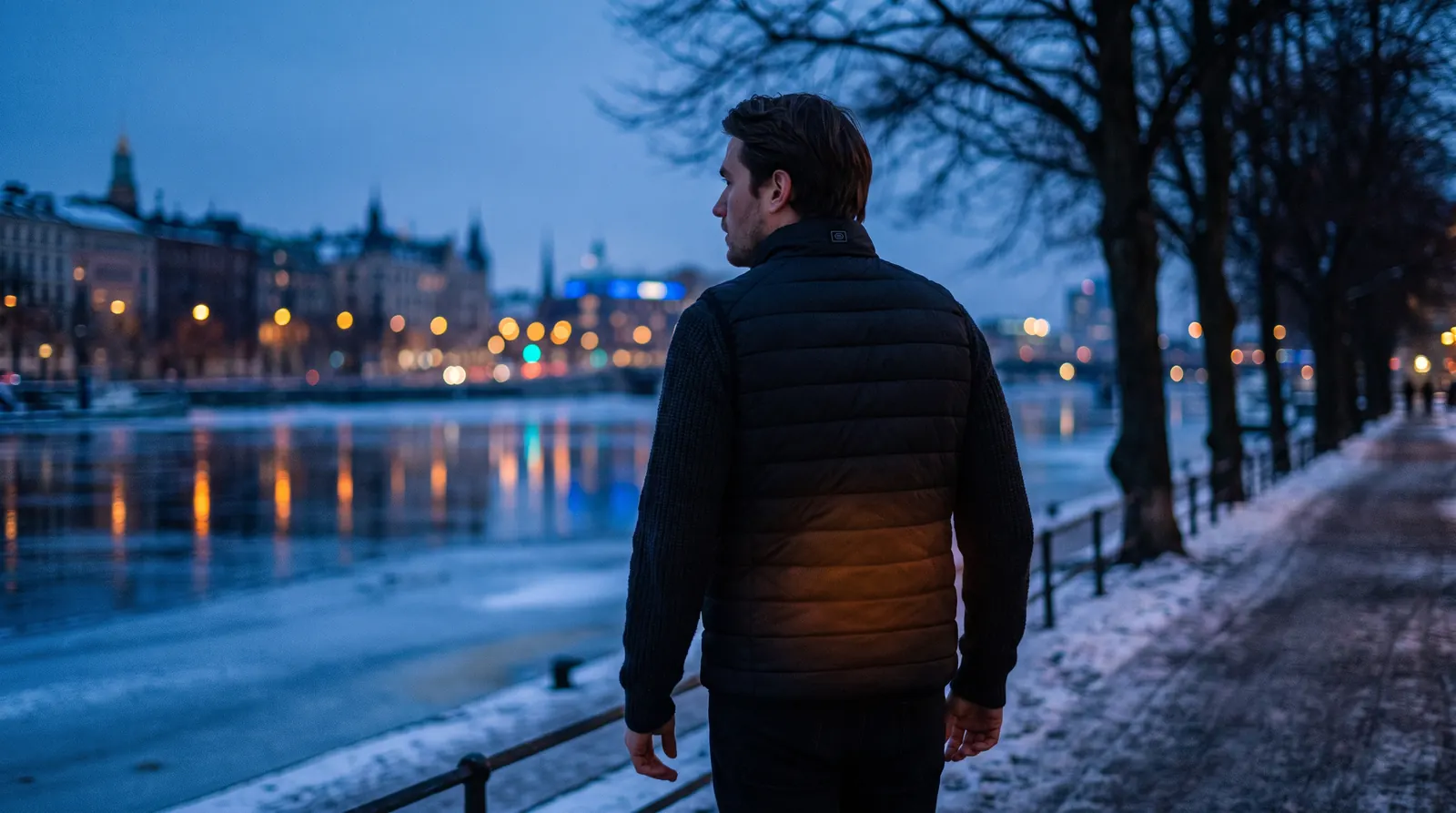
A heated vest warms your core – and your core decides how warm your hands and feet stay. We compare heating zones, battery and runtime of current men's and women's models.
Updated September 30, 2026 · 7 models · manufacturer specs with sources only
Ororo
The best balance of stated runtime and price in this comparison.
Venustas
Another documented option with a different focus.
Fieldsheer
Another documented option with a different focus.
Short answer: A good heated vest heats your back and chest, lists a clear battery spec (volts and mAh, or watt-hours), and runs 6 to 13.5 hours on low according to the manufacturers. Check whether the battery is included – several tool-brand vests ship without one. If you already own Milwaukee M12 or Makita LXT batteries, a tool-battery vest is the cheapest path. Everyone else is best served by a vest with its own 7.4V battery.
A heated vest is the most versatile piece of heated clothing you can buy. It goes under the coat you already own – at a December game, in a deer stand, on a cold commute or on a job site. Heating panels sit on your back, chest, collar or in the hand pockets, and a small lithium battery rides in an inside pocket.
A vest heats the part of you that matters most: your core. When you get cold, your body cuts blood flow to your hands and feet to protect your organs. Keep your core warm and your body lets more heat reach your fingers. That's why a heated vest often helps with cold hands, too.
Compared with a heated jacket, a vest has three practical advantages:
A jacket makes more sense if you want weather protection and heat in one layer, or if your arms get cold. Vests never heat the arms.
| Model | Runtime (low/med/high) | Battery | Price |
|---|---|---|---|
| Ororo Men's Classic Heated Vest (Black, EU) Everyday · Heating zone: back, pockets, collar |
10 h 6 h 3 h |
7.4 V4800 mAh35.5 Wh | $179.99
Check price*
|
| Venustas Men's Classic Heated Vest 7.4V (M2118) Everyday · Heating zone: shoulders, back, pockets, collar |
9.5 h |
n/a | $199.99
Check price*
|
| Fieldsheer Alpine 3.0 Heated Vest Men's Softshell · Heating zone: chest, back |
9 h 2 h |
7.4 V2250 mAh16.6 Whmax. 135 °F | $199.99
Check price*
|
| Ororo Women's 5-Zone Classic Evo Heated Vest Everyday · Heating zone: back, pockets, collar |
8 h 5 h 2.5 h |
7.4 V5075 mAh37.6 Wh | $199.99
Check price*
|
| Gerbing 7V Men's Khione Puffer Heated Vest 2.0 Down · Heating zone: chest, back, collar |
8 h 2 h |
7 V3400 mAh23.8 Whmax. 135 °F | $199.99
Check price*
|
| Ororo SureWarm Classic Pro 6-Zone Dual-Control Vest (Men's, EU) Everyday · Heating zone: back, pockets, collar, chest |
7 h 4.5 h 2.5 h |
7.4 V5075 mAh37.6 Whmax. 122 °F | $239.99
Check price*
|
| ActionHeat Pro Series+ Bluetooth Women's Puffer Heated Vest Everyday · Heating zone: chest, back, collar, pockets |
6 h 3 h 2 h |
n/amax. 151 °F | $229.99
Check price*
|
All values from the manufacturer's page, retrieved September 30, 2026. “n/a” = not stated by the manufacturer. Runtimes are usually quoted at room temperature. Models marked “other market” have no US dollar price listed.
The table shows manufacturer specs as of the date we pulled them. Runtimes apply to the listed heat setting and the included or recommended battery. An empty cell means the manufacturer doesn't publish that number.
Zone count means little until you know where the zones are. The panels that matter most are the mid and upper back and the chest. Heated hand pockets are great if you skip gloves. A heated collar feels nice but matters less under a high jacket collar.
A few examples from our comparison:
Most heated vests run on 7.4V. Comparing mAh alone is misleading when voltages differ. Watt-hours make batteries comparable: volts × amp-hours = Wh.
| Vest | Battery (manufacturer spec) | Energy |
|---|---|---|
| ororo Women's Classic Evo | 7.4V, 5,075 mAh | 37.5 Wh |
| Venustas M2118 | 7.4V | 36 Wh (stated) |
| Gerbing Khione 2.0 | 7V, 3,400 mAh | 25.16 Wh (stated) |
| Fieldsheer Alpine 3.0 | 7.4V, 2,250 mAh | 16.7 Wh |
| ActionHeat Pro Series+ puffer | 10,000 mAh power bank | voltage not stated |
The Fieldsheer has the smallest battery here, yet Fieldsheer quotes 9+ hours – on the lowest of four settings. ActionHeat lists only mAh for its USB power bank, so you can't calculate its watt-hours from the product page.
For the math on spare batteries and power banks, see our guide to heated clothing battery life.
The number on the box is the longest runtime, and it's always for the lowest setting. On a 20 °F (−7 °C) morning with wind, you'll likely run medium or high. Manufacturers put those at roughly 2 to 4.5 hours. Lithium batteries also deliver less energy in the cold, so keep the battery in an inside pocket close to your body.
Some brands give a single number. Venustas says "up to 9.5 hours" for the M2118 without naming a setting. ActionHeat lists 6+ / 3+ / 2+ hours. Those "+" figures are minimums, not exact runtimes.
ororo contradicts itself on the Women's Classic Evo: the spec block lists 7.5 / 4.5 / 2 hours, while the FAQ on the same page lists 8 / 5 / 2.5 hours for another variant. We use the spec block.
This is the biggest hidden price difference. In our comparison:
Milwaukee and Makita build heated vests around their tool batteries. If those batteries are already on your truck, you skip the most expensive part. Both vests in our data are European listings, so check that the US model takes the same battery.
The Makita DCV202 shows what a big battery does. With an 18V 6.0Ah pack, Makita lists 35 / 20 / 10 hours; with 5.0Ah, 28 / 16 / 8 hours. No vest with its own battery comes close. The trade-off is a much heavier pack on your hip. Milwaukee lists up to 11 hours for its M12 vest with a 3.0Ah battery and says it is washer and dryer safe.
Tool-battery vests are cut for work. For a tailgate or a night downtown, a regular vest is slimmer.
A heated vest only works when the panels touch your body. A loose vest wastes heat. In our comparison, ororo and ActionHeat offer dedicated women's cuts. Several European brands sell unisex sizing only. With unisex vests, read the size chart carefully. The sections on the heated vest for women and the heated vest for men below list the models by cut.
Few brands publish weight, which is a shame, because weight is what you notice after six hours in a stand. Here's what we have:
| Vest | Weight (manufacturer spec) |
|---|---|
| Glovii GV1 (EU) | 440 g (15.5 oz) with battery, 250 g (8.8 oz) without |
| Makita DCV202 (EU) | 500 g (17.6 oz), listed "including battery" |
| ororo Women's Classic Evo | 520 g (18.3 oz) with battery, size M |
The Makita figure is hard to square with an 18V 6.0Ah tool pack, which alone is heavy; we report it as Makita lists it. ororo also sells a model it calls a lightweight heated vest, but it isn't in our comparison yet, so we don't have verified specs for it. If weight matters to you, compare the vest without battery and the battery separately. A lightweight heated vest with a small battery is great for a commute but may not last through a long sit.
Vests aren't rainwear. Most are water-resistant at best – your outer layer handles the weather. ororo, Fieldsheer, ActionHeat, Venustas and Milwaukee describe their vests as machine washable. Gerbing doesn't give washing instructions on the Khione product page. Step-by-step instructions are in our guide on how to wash a heated vest.
Two vests in our comparison are cut specifically for women, and both are sold in the US:
For Europe, G-Heat sells its EVO vest in a women's cut (€169.90 with battery). When you shop for a heated vest for women, look at the back panel first. It has to sit flat against your back even if the vest fits around the chest. A slightly longer, tapered cut keeps your lower back covered when you bend or sit.
The men's side has more choice. In the US, our comparison includes:
Beyond that, ororo's men's vests and the Milwaukee M12 vest are in our data from their European listings (see the brand sections below). Makita's DCV202 is listed as unisex but cut as a work vest.
The real question for a heated vest for men is usually everyday versus work. For game days and commutes, a slim vest with its own battery is enough. On a job site, the vest that runs on your existing tool batteries wins.
ororo is the brand most people search for when they look for a heated vest. Three ororo vests are in our comparison:
We don't have US prices for the two men's models, so check ororo's US store before you compare them with the other vests here.
Milwaukee is the other big name, mostly because so many people already own M12 batteries. The vest in our data is the M12 HPVBL3 quilted vest from Milwaukee's European site. Per Milwaukee, it has 2 zones (chest and back), 3 settings and runs up to 11 hours on an M12 REDLITHIUM 3.0Ah battery. It is washer and dryer safe, with the dryer at up to 140 °F (60 °C); battery and holder come out first.
Three things are worth knowing before you buy. It ships without battery or charger. Milwaukee gives only the best-case runtime, not hours per setting. And there's no price on the manufacturer page, so you'll only see one at a retailer. The US listing may differ in details, so check that the model number matches. If you're choosing between a Milwaukee heated vest and a jacket, our heated jacket comparison includes Milwaukee's M12 AXIS jacket kit.
Best for: everyday cold – commutes, walks, games. Per ororo: 5 zones, 3 settings, 7.5 / 4.5 / 2 hours with the included PD 5K battery (37.5 Wh), 520 g (18.3 oz) with battery in size M, $199.99. Catch: The product page gives two different runtime sets (see above).
Best for: people who want fine control over heat. Per Fieldsheer: 4 settings from 90 to 135 °F (32–57 °C), 3 zones, 9+ / 4+ / 3+ / 2+ hours, battery included, companion app, $199.99. Catch: At 16.7 Wh, the battery is small. Expect roughly 2 hours on high.
Best for: a warmer puffer look with heat up to 135 °F (57 °C). Per Gerbing: 4 zones, 4 settings – 2 hours at 100 %, 3 at 75 %, 5 at 50 %, 8 at 25 %. Battery rated 25.16 Wh, included. $199.99. Catch: No care instructions on the product page. Version 2.0 has been listed since 2023.
Best for: app control and the highest top setting in the group. Per ActionHeat: settings of 150 / 130 / 115 °F (66 / 54 / 46 °C), 6+ / 3+ / 2+ hours, 10,000 mAh USB power bank included, $229.99. Catch: Battery voltage isn't listed, and runtimes are the shortest in this group.
Best for: shoulder heat – rare in vests. Per Venustas: 6 zones including both shoulders, 36 Wh battery, "up to 9.5 hours," machine washable, $199.99. Catch: No runtime per setting, and the number of settings isn't stated.
Best for: Makita LXT owners who need full shifts. Per Makita: 4 zones on chest and back, 3 settings, 35 / 20 / 10 hours with an 18V 6.0Ah battery. Catch: No price or care instructions on the manufacturer page. Bare-tool versions come without battery.
In a tree stand, runtime beats peak temperature. You sit still for hours before sunrise, often below freezing, and you can't swap batteries without moving. Look for heat on the back, the biggest battery you can get and a quiet outer layer – that part comes from your hunting coat, which is exactly why a vest makes sense here. Among the vests in our data, ororo's men's Classic lists the longest own-battery runtime at 7.5 hours on medium. Tool-battery vests go longer if you carry a big pack. Our page on heated hunting gear covers socks and gloves for the stand as well.
Manufacturers list about 6 to 13.5 hours on low and 2 to 4 hours on high. Large tool batteries go further: Makita quotes up to 35 hours with a 6.0Ah pack. In real cold, expect less, because lithium batteries deliver less energy at low temperatures.
Most, yes – typically on a cold or gentle cycle. Remove the battery first and tuck the cable away. Milwaukee calls its M12 vest washer and dryer safe; for the others, air drying is the safe choice. Details are in how to wash a heated vest.
If you spend hours sitting or standing still, usually yes: tree stands, bleachers, ice fishing, outdoor work. When you're hiking or cycling, your own body heat often does the job. Factor in the battery price if it isn't included.
There's no single best brand, and we don't run hands-on tests ourselves. It depends on what you need. In our data, ororo lists the largest own-brand battery, Fieldsheer offers the finest control with four settings, and Makita and Milwaukee make sense if you already own their tool batteries. Compare runtime on medium and whether the battery is included, not the logo.
Yes, when used as intended. They run on low voltage, usually 7.4V, so shock isn't the issue. Don't run the high setting for hours against bare skin, use the charger that came with the battery, and check the cable and connector for damage. If you have reduced sensation, for example from diabetes, ask your doctor first, because you may not notice too much heat.
A vest is more flexible because it goes under any coat. A jacket gives you weather protection and, on some models, heated arms in one piece. If you already own a good winter coat, the vest is usually the better buy.
The vest itself can fly; the lithium battery belongs in your carry-on. Typical vest batteries are well below the 100 Wh limit. A large 18V 6.0Ah tool battery, however, comes to 108 Wh. See heated clothing on planes.
Many vest batteries have a USB output – check the product description. Every phone charge comes out of your heating time.
* Links marked * are affiliate links. If you buy through them we may earn a commission at no extra cost to you. Placements can't be bought.