UT4 Extreme
Ocoopa
- Runtimelow18 h
The best balance of stated runtime and price in this comparison.
$39.99per manufacturer, Sep 30, 2026
Check price*
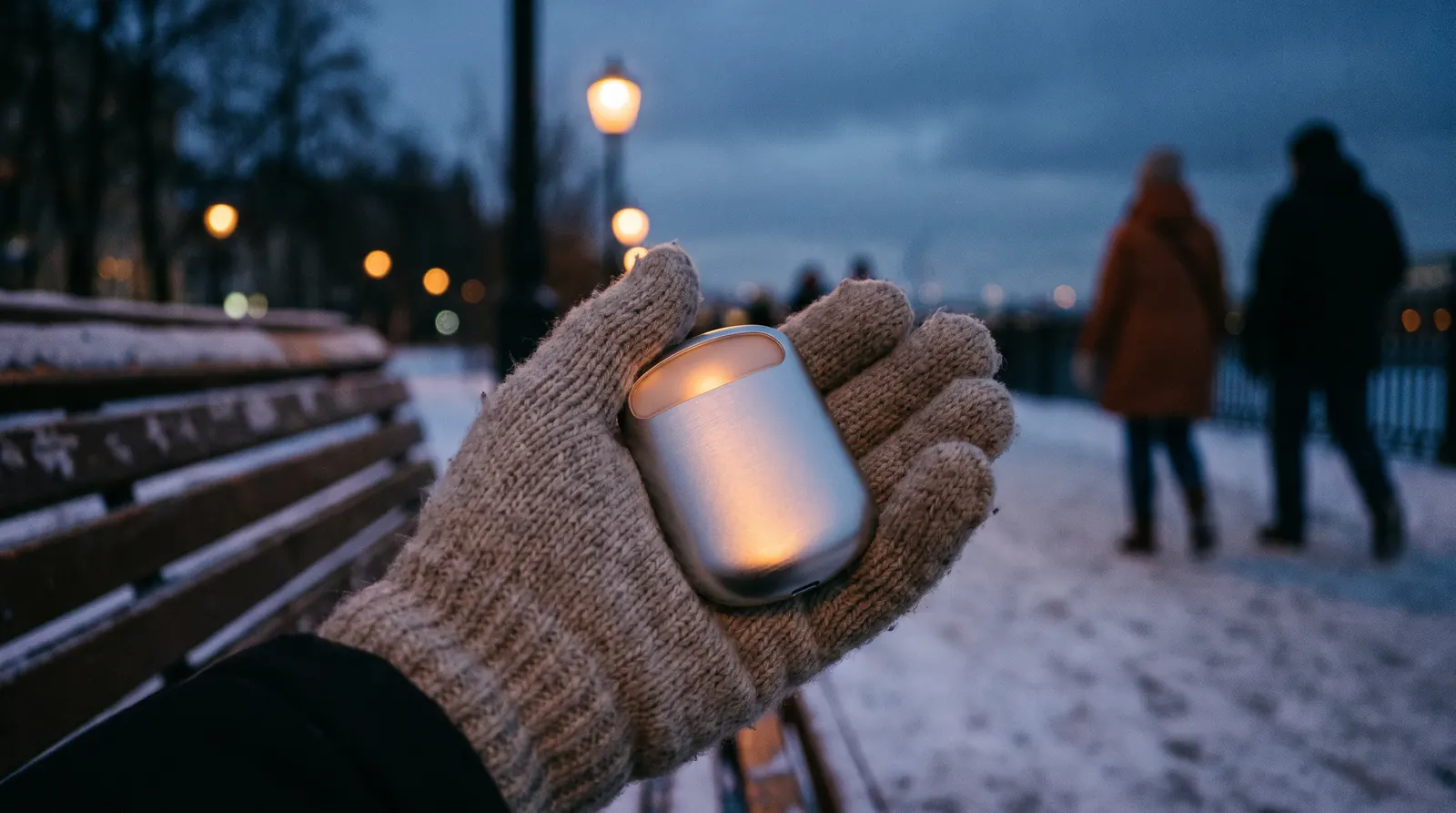
A rechargeable hand warmer costs a fraction of a heated glove. We compare runtime, temperature and weight – and tell you when one is enough.
Updated September 30, 2026 · 9 models · manufacturer specs with sources only
Ocoopa
The best balance of stated runtime and price in this comparison.
Ocoopa
The lowest price in the comparison – for occasional cold.
Ocoopa
Another documented option with a different focus.
Short answer: Rechargeable hand warmers are the cheapest way to fix cold hands. Per manufacturer specs, the models we compare run 6 to 18 hours on low and top out between 118 °F and 136 °F (48–58 °C). One is enough when you can tuck your hands into your pockets – walking the dog, waiting at the bus stop, sitting through a late-season game. If your hands have to work outside, you need heated gloves instead.
This question matters more than any spec sheet. Both warm your hands, but in completely different ways.
A hand warmer is a little heater for your pocket. You hold it or keep it in your jacket, and it warms you while you're holding it. The moment you pull your hands out to do something, the heat stays behind. A heated glove keeps working while you grip ski poles, hold handlebars or shovel the driveway.
| Rechargeable hand warmer | Heated gloves | |
|---|---|---|
| Price per manufacturer | $24.99 to $49.95 (muff $159.99) | mostly $170 to $310, up to $550 |
| Warms while you grip | no | yes |
| Warms fingertips | only when you wrap your hand around it | depends on heating zone |
| Runtime on low (manufacturer spec) | 6 to 18 hrs | 7 to 13 hrs |
| Bonus | often doubles as a phone power bank | touchscreen tips, some app control |
| Washing | not an issue | battery out, follow the label |
So here's the honest take: for breaks, walks and standing around, a hand warmer does the job for a fraction of the money. For anything where your hands are busy outside, gloves win. Plenty of setups combine both – light gloves plus a warmer in the pocket for downtime. Our heated gloves comparison lists runtime per heat level for the glove side. Not sure what you need? The Warmth Finder sorts it out in about ten seconds.
Brands almost always give one number: runtime on the lowest setting. Only ActionHeat and Ororo list runtime for every level. Ocoopa gives the UT3 Pro a range of 6 to 15 hours. On high, expect much less than the headline number.
One thing stands out. Ocoopa's UT2s has two pieces with 5,000 mAh each and is rated "over 8 hours on low." The UT3 Pro also has 2 × 5,000 mAh but claims up to 15 hours. Same capacity, nearly double the runtime – a good reminder that brands don't all measure the same way. Treat runtime claims with some skepticism.
Hand warmers advertise mAh, but almost none list the voltage. Without voltage, you can't calculate watt-hours, the number that actually compares batteries. A 7.4V, 2,000 mAh glove battery holds 14.8 Wh. A 5,000 mAh hand warmer sounds much bigger. But lithium cells typically run at a nominal 3.6 to 3.7V, which would put 5,000 mAh at roughly 18 Wh – only a little more, not three times as much. That's a back-of-the-envelope estimate, not a manufacturer number.
Lithium batteries also lose capacity in hard cold. A warmer in an inside pocket stays warmer than one in an outer pocket. Our guide to heated clothing battery life explains why.
A lot of people want a rechargeable hand warmer that slides into a glove or mitten. None of the brands in our comparison markets a model specifically for that, so check dimensions and weight. The smallest one we track with a listed weight is the Ocoopa UT5 DuoHeat at 2.36 oz, though Ocoopa doesn't say whether that's one unit or the pair. The Stoov Stoons measures about 1.6 × 4 inches (4 × 10 cm). Anything the size of a phone power bank will press on the back of your hand and cut circulation in a snug glove. If you want heat inside the glove, a mitten with room to spare, a thin disposable warmer or a heated glove is usually the better fit.
Max temperatures run from 118 °F (48 °C) on the Stoov Stoons to 136 °F (58 °C) on the Ocoopa UT2s and UT3 Pro. Hotter isn't automatically better. Held directly in your hand on high for a long time, these get uncomfortable. Medium is often plenty inside a pocket.
There are three designs. Single-unit warmers like the Zippo HeatBank sit in one hand. Split models like the Ocoopa UT2s, UT3 Pro and ActionHeat Classic Dual snap apart magnetically, so each hand gets one. The Ororo Bay City is a heated muff you buckle around your waist and slide both hands into.
Most models can charge your phone in a pinch – at the cost of heating time. Zippo rates the HeatBank 6 Pro at IP57, and Ocoopa rates the UT4 Extreme at IP56. Both add a flashlight. Not every brand lists weight: Zippo gives 0.35 lb for the 9s and 6.43 oz for the 6 Pro.
The battery is built in, and it's lithium. It belongs in your carry-on, never in a checked bag. Many models double as power banks, and the TSA treats power banks as carry-on only. Some airlines go further and ban using or charging power banks on board – check yours before you fly. Our guide to heated clothing on planes sums up the rules.
Used properly, they're about as safe as your phone. But two risks are real, and one of them made headlines this summer.
On July 30, 2026, the U.S. Consumer Product Safety Commission (CPSC) announced a recall of about 1.5 million Ocoopa rechargeable hand warmers (recall number 26-659). The lithium-ion battery can overheat and ignite. Per the CPSC, Ocoopa received 1,480 reports of overheating, including 15 fires and 350 burn injuries, and an 83-year-old consumer in San José, California, died in February 2026.
The recall covers model numbers UT3053 (UT3 Lite), UT3056 (UT4 Young), ZLS-118, ZLS-118S, ZLS-118D, H01 and H01(PD), sold from September 2018 through May 2026 on Amazon, Walmart.com and Ocoopa's own sites for $15 to $60. The model number and a three-digit batch code are printed on the underside. If yours is on the list, stop using it and file for a refund through Ocoopa's recall page.
The Ocoopa models in our comparison – UT2s, UT3 Pro, UT4 Extreme and UT5 DuoHeat – aren't on the recall list. Watch the names: the recalled UT3 Lite and UT4 Young sound a lot like the UT3 Pro and UT4 Extreme. Always check the model number on the device itself.
The models here reach 118 to 136 °F (48–58 °C), per the manufacturers. That feels merely warm at first, but hours of contact on one spot can still burn skin – especially if you have reduced feeling from diabetes or numb fingers.
The table lists every model with solid manufacturer specs. A blank cell means the brand doesn't publish that number.
| Model | Runtime (low/med/high) | Battery | Price |
|---|---|---|---|
| Ocoopa UT4 Extreme Outdoor · Hunting · Powerbank |
18 h |
n/a | $39.99
Check price*
|
| Ocoopa UT3 Pro Magnetisch-zweiteilig · Powerbank · Heating zone: Both sides |
15 h 6 h |
n/amax. 136 °F | $29.99
Check price*
|
| Ororo Bay City Heated Hand Warmer 2.0 Muff · Huefttasche · Heating zone: Three zones (front left/right, back) |
14 h 9 h 5 h |
7.4 V4800 mAh35.5 Wh | $159.99
Check price*
|
| Zippo HeatBank 9s Powerbank · Heating zone: Both sides |
9 h |
n/amax. 122 °F | $49.95
Check price*
|
| Ocoopa UT2s (MagTwins) Magnetisch-zweiteilig · Powerbank · Heating zone: 270° per half, 360° combined |
8 h |
n/amax. 136 °F | $39.99
Check price*
|
| Ocoopa UT5 DuoHeat Kompakt · Duo-pack · Heating zone: Both sides |
8 h |
n/amax. 126 °F | $24.99
Check price*
|
| ActionHeat Classic Dual Magnetic Hand Warmer Magnetisch-zweiteilig · Heating zone: Both sides |
8 h 6 h 4 h |
n/amax. 129 °F | $29.99
Check price*
|
| Zippo HeatBank 6 Pro Outdoor · Powerbank · Heating zone: All round (360°) |
6 h |
n/amax. 122 °F | $44.95
Check price*
|
| Stoov Stoons Infrarot · Powerbank · Heating zone: Both sides · other market |
10 h |
n/amax. 118 °F | n/a
Check price*
|
All values from the manufacturer's page, retrieved September 30, 2026. “n/a” = not stated by the manufacturer. Runtimes are usually quoted at room temperature. Models marked “other market” have no US dollar price listed.
Two magnetic halves with 5,000 mAh each. Ocoopa lists 6 to 15 hours of runtime and four levels from 100 °F to 136 °F (38–58 °C), heating both sides. Price runs $29.99 to $42.99 depending on color.
Catch: the runtime range is very wide, and no per-level breakdown is given. The UT3 Pro isn't on the July 2026 recall list, but the similarly named UT3 Lite (UT3053) is – check the model number on the underside.
At 10,000 mAh, the UT4 Extreme has the biggest battery of any pocket warmer here. Ocoopa claims up to 18 hours in standard mode, plus an extra-power mode, IP56 protection, a flashlight and PD fast charging. The camo version makes sense for hunters – see our heated hunting gear guide for the rest of a cold-weather setup. List price is $39.99.
Catch: Ocoopa doesn't list heat levels or temperature.
A built-in 5,200 mAh battery and six settings: three heat one side, three heat both. Zippo lists up to 122 °F (50 °C) and up to 9 hours of runtime. It weighs 0.35 lb and costs $49.95.
Catch: Zippo ships it only within the contiguous U.S.
A two-piece magnetic warmer and the only pocket model here with runtime for each setting: 8, 6 and 4 hours at 105, 115 and 130 °F (41, 46 and 54 °C). USB-C charging, $29.99.
Catch: ActionHeat doesn't list battery capacity.
Not a pocket warmer but a waist-mounted muff with three heating zones. The Mini 5K battery is 7.4V and 4,800 mAh, or 35.5 Wh. Ororo lists 14 hours on low, 9 on medium and 5 on high. The 185 g battery has a USB output and takes 4 hours to charge.
Catch: at $159.99, it costs close to a pair of heated gloves.
Stoov is a Dutch brand. The Stoons has three levels up to 118 °F (48 °C), runs up to 10 hours, heats both sides, charges your phone and measures about 1.6 × 4 inches (4 × 10 cm). A USB-C cable is included.
Catch: Stoov doesn't publish capacity, and it's the coolest-running model in this comparison. We only have a euro price (€59.95), no confirmed U.S. price.
It depends on your day. For the longest listed runtime in a pocket warmer, Ocoopa claims up to 18 hours for the UT4 Extreme. If you want runtime per heat level, the ActionHeat Classic Dual Magnetic lists all three. For both hands at once on a long sit, the Ororo Bay City muff lists 14 hours on low. If you already own an older Ocoopa warmer, check its model number against the recall list in the safety section above.
Per manufacturer specs, 6 to 18 hours on low depending on the model. On high it's much shorter – ActionHeat lists 4 hours. Hard cold and charging your phone at the same time cut runtime further.
Not better, just different. A hand warmer is far cheaper and often charges your phone too. But it only warms you while you hold it. For skiing, riding or outdoor work, heated gloves are the better tool.
The models here top out between 118 °F and 136 °F (48–58 °C), per the manufacturers. That's warm enough to get uncomfortable after a while. Start on low or medium.
Yes, in your carry-on only. The lithium battery is built in and can't go in checked luggage. If it doubles as a power bank, some airlines add rules, such as no use on board.
Outside warmth can ease symptoms, and a hand warmer is an inexpensive way to get it. It doesn't replace a visit to your doctor. Our guide to heated gloves for Raynaud's covers what to look for and which gloves heat into the fingertips.
For regular use, usually yes: you recharge instead of rebuying, and you can switch heat levels. Disposable warmers have no battery to worry about on a flight and don't need charging. If you only need warmth a few times a season, disposables are fine.
* Links marked * are affiliate links. If you buy through them we may earn a commission at no extra cost to you. Placements can't be bought.